
“Precision Medicine Summer Internship Program”
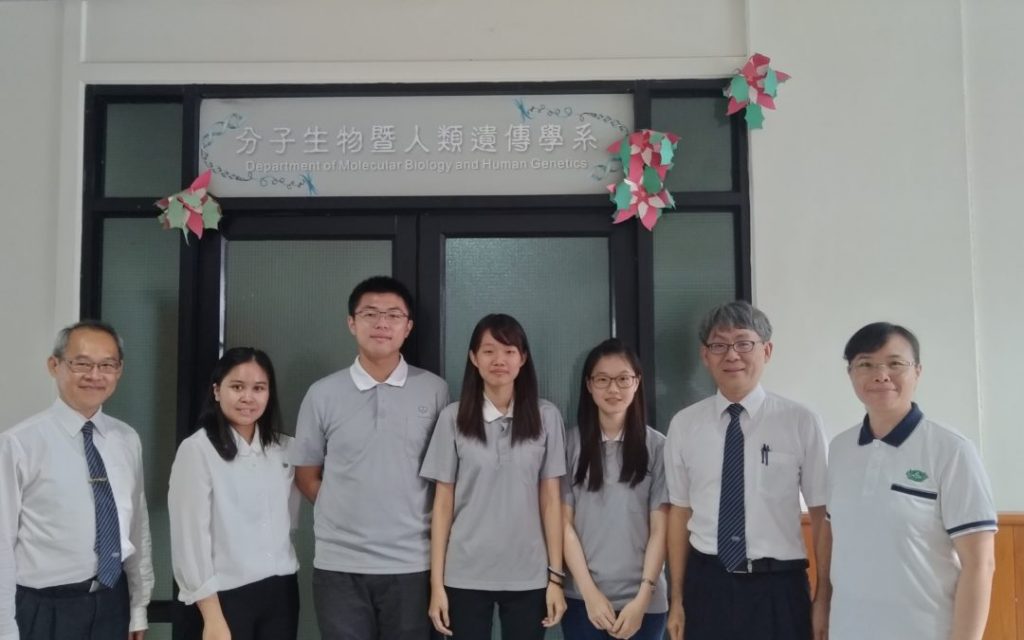
Jiayi Li and Dohar Manalu, the students of the Department of Molecular Biology and Human Genetic, won an award from the National Health Research Institutes for their efforts on the “Precision Medicine Summer Internship Program” provided by National Health Research Institutes
After completing their junior year, Jiayi Li and Dohar Manalu chose to participate in “Asia Pacific Biomedical Silicon Valley Precision Medical Flagship Project – Precision Medical Talent Cultivation Program” sponsored by The National Health Research Institutes, and they were awarded for their outstanding performances.
In March this year, the National Health Research Institutes announced that “Asia Pacific Biomedical Silicon Valley Precision Medical Flagship Project – Precision Medical Talent Cultivation Program” would be available in the summer, and four students of our department were selected, namely, Dohar Manalu, Xianghe Chen, Peichen Liao, and Jiayi Li. For a period of two months, they received a 60-hour bioinformatics training provided by the National Center for High-Performance Computing, consisting of introduction to information technology, Linux operating system, introduction and operation of digital biometrics software. In addition, they took courses once a week at the National Health Research Institutes, and the courses were experiment safety, ethics, genetic technology, precision medicine, and learning health systems. Moreover, students were guided by their mentors from the National Health Research Institutes, and learned with their peers from all over the world.
When this program came to the end, students gave a 10-minute presentation of what they learned from this program, and went through a 3-minute Q & A session, and they did their best. Jiayi Li and Dohar Manalu were awarded for their efforts in the program.
Jiayi Li mentioned that learning new experimental technique was not her focus, and instead, she tried to learn how to see things clearly and carried things out in a more flexible way, which would keep her research projects going and be helpful for getting acceptance from faculty advisor. Furthermore, she learned that reading a paper enables us to know how an author conducted his/her research, and furthermore, we can go deeper into the things behind it and understand why he/she carried it out this way. Going through this program, Jiayi is pretty sure that she is suitable for doing research.
Dohar Manalu is an Indonesian student, and she said that she loved a wide range of courses provided by the National Health Research Institutes (NHRI), including workshop, biomedical education and training, etc. In addition to acquiring new knowledge, she had a chance to review what she has learned at school. It was a wfantastic experience for her.
Almost half of those who have completed their junior year chose to participate in internship program in the summer break. Many hospitals, pharmaceutical companies, biotechnology companies, Bureau of Standards, Metrology & Inspection, National Health Research Institutes, etc. opened their doors for our students. Dr. Peng Yeong Woon, Chair of the Department of Molecular Biology and Human Genetics, thanks faculty members for exercising their connections to look for willing organizations, and accompanying students to gain their experiences. Students were able to experience how organizations operated and the workplace that they are going to face in the near future. Some students were highly regarded in their place of work, thus they have decided to work for those institutions right after graduation.
The Asia Pacific Biomedical Silicon Valley Precision Medical Flagship Project aims to establish a solid foundation for Taiwan to develop its biotechnology and healthcare industries, by employing precision medicine and learning health system (LHS). This program comprises three parts, which are sponsored by the National Health Research Institutes (NHRI) of the Ministry of Health and Welfare, the Department of Life Sciences of the Ministry of Science and Technology, and the National Center for High-performance Computing, respectively. It focuses on enhancing industry-university collaboration, carrying out innovative research, and building an infrastructure for biomedical information.